
STUDIO DIARY 002 • (2/27/26)
Some serious studio dorking ensues as I'm joined by Martin Feveyear to dial piano and drum sounds.
As I compose the score for a feature film, I am documenting my progress in short, bite-sized posts. At least that’s the idea. Lord knows I can be long-winded when it comes to all things studio—and creativity in general—so brevity may not be in the cards. We’ll see how it goes.
FEBRUARY 20, 2026
Pre-production for Supermassive continues while director Steve Utaski and editor Jason McKee work on a ‘pacing pass.’ After a second work-in-progress screening, they have an eye on tightening up the cut.
Knowing scenes could change—and maybe even go away—I’m holding off on committing anything real to tape. (I still call it committing to tape. Committing to hard drive just doesn’t have the same ring to it.)
I’ve been digging deeper into the most recent cut, gathering my thoughts and making notes in preparation for our spotting session. A spotting session is a meeting where the director and composer decide exactly where music should begin and end, and what emotional tone it should serve at each moment.
And I’ve been building out sessions in my DAW1 so when the starting gun fires, I can jump right in and start tracking.
The man with magic ears, Martin Feveyear, stopped by the studio this week to help me dial in acoustic piano and drum sounds. Now, I’m a good engineer. Maybe even really good. But Martin is great.
Martin and I go way back. He ran front of house for The Sinners and me back in the mid-nineties. In addition to making us sound great, he kept us in stitches. Regular readers of Love Songs Etc may remember the photo capturing his patented ‘Geek Dance’ from this post from February 13, 2026.
I was interested to get his take on recording my Yamaha U3 upright piano and the funky little drum kit I’ve set up for this gig.
We really dorked out. After listening to the mid-side stereo mic array I’d been playing with for the piano, we had a shootout and listened to the difference it made when pulling the piano away from the wall. The difference was massive. Against the wall, it sounded bloodless and pale. With room to breathe, the piano bloomed with color.
We could hear that some bass trapping would help refine the sound, so I pulled a few of my ASC Tube Traps from the control room and strategically placed them in the corner and directly behind the piano. They helped a lot. Those suckers are spendy, so it was nice to hear them do so much to tighten up the low end.
Next, we tried Martin’s chosen piano micing technique with a pair of borrowed Kiwara KA-251E clones. Immediately, listening on headphones as I played, I was convinced that this was the way to go. My hunch was confirmed when I heard the lovely stereo imaging emanating from my ATC SCM25 studio monitors.
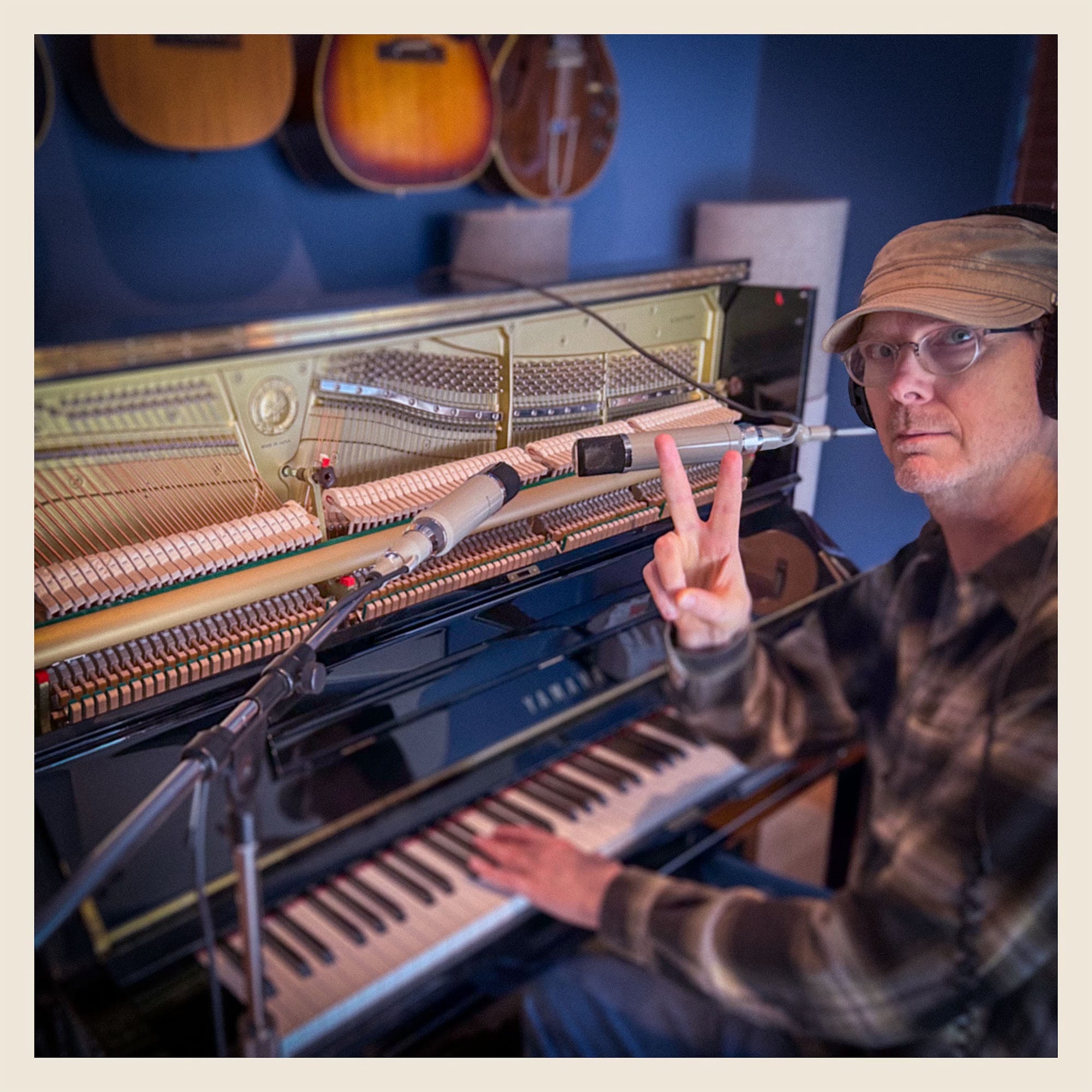
While this sounded fantastic, Martin had another trick up his sleeve: micing the soundboard from behind. For this job, we chose a Shure KSM-32. It’s not a fancy, expensive mic, but Martin loves it. Panned up the middle, it “really tied the room together” as The Dude would say.
Adding a high-pass filter to the back mic with Fab Filter’s Q4 plug-in helped to focus the sound. We considered using the mic's filter, but opted to record the full spectrum, giving me more control at mixdown.
In my previous post, I mentioned touching up a few snare drums. While I knew I wanted to use my little ‘Patriots’ marching bass drum, I had not given it any love yet.
I was certain it would benefit from some dampening. I decided to wait and see how Martin would tackle the task. He showed me a technique I hadn’t seen before. Watch as he uses gaff tape and paper towels to tame the ringing.
Below is a quick lesson on micing a kick drum. The mic of choice is my Wunder CM7 FET. The FET 47 is a common choice for kick drum for its fast transient response and ability to handle high SPL2. Many engineers use it in combination with a second mic, but I’m all about keeping things simple on this gig, so I’ll stick with just the one.
I was turned onto this kick drum by session cat extraordinaire, Matt Chamberlain. He played one on “Two of the Lucky Ones” during The Droge & Summers Blend sessions. Check out this post from August 23, 2023, to see a picture of Matt’s kit from that session.
I fell in love with the sound of his groovy little ‘Patriot’ drum, and as fate would have it, there was one just like it on eBay.
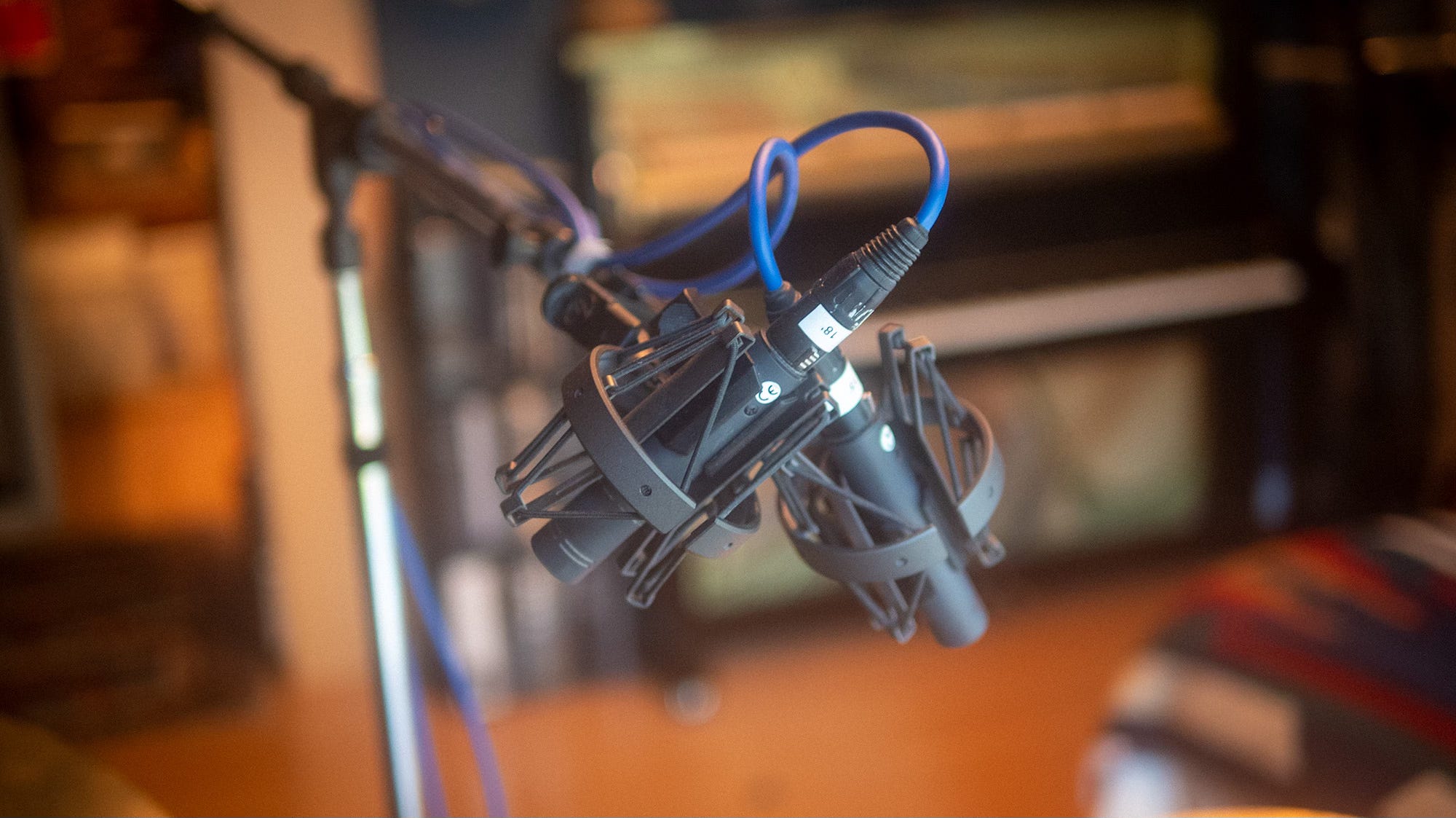
Finally, we addressed the overheads. Over the years, I’ve often used the X/Y micing technique. But for this project, I wanted more width than X/Y typically delivers. Last week, I set up my Neumann KM184s in ORTF stereo, a method devised by Office de Radiodiffusion Télévision Française in the 60s. I didn’t spend much time refining the placement. Right away, it sounded pretty darn good.
Martin futzed with the positioning by lowering the mics, narrowing their angle, and tilting them to center the snare and capture more detail from the cymbals. Just like on the piano, with headphones on while playing, I could immediately tell that his moves made a noticeable improvement.
I’m champing at the bit to start committing these sweet tones to ‘tape.’ But I’ll just have to be patient as I wait for the next cut.
I’ll be back in your inbox later with another installment of Studio Diary. Until then…
Peace & Love Songs,
Pete
IN THE PUZZLE TREE RECORDS ONLINE STORE
Fade Away Blue • My latest full-length
Necktie Second (Deluxe) • 2xLP reissue of my 1994 debut
Plus old records, shirts, posters & a mug
• • •
LIVE & IN-PERSON
07/23-07/25 - Union, WA • Peace Love & Union Saltwater Songwriters Festival
DAW stands for digital audio workstation.
SPL stands for Sound Pressure Level.
That was a fun read! I would’ve loved to have been there just to see that happen.
Alright, after all this I gotta go towel off.